Where to Find Steampunk STL Files and Designs Worth Printing
You have a printer, a spool of something brass-coloured and a nagging feeling that the machine is capable of more than calibration cubes. What you lack is a decent supply of steampunk files. Searching “steampunk” on a model site returns about forty thousand gears, and roughly four of them are worth the filament.
As an Amazon Associate I earn from qualifying purchases and sometimes recommend products from other sellers at no extra cost you. For more details see my disclosure policy and privacy policy.
This is my map of where steampunk STL files actually live, sorted by what each source is good for, plus a quick method for judging a file and its licence before you commit a single gram of plastic. Printing, supports and finishing are covered in my guide to 3D printing steampunk props and decor, so this post sticks to the hunt.
⚙️ What Makes a Steampunk STL Worth Printing
Before the shopping, the standard. A good steampunk file has clean geometry, meaning no holes in the mesh, no inside-out faces and no walls so thin your slicer shrugs and ignores them. It also has a sensible print orientation, so the pretty face does not need supports clinging to it like barnacles.
Detail matters too, and it has to survive your layer height. Rivets, engraved filigree and tiny teeth look glorious in a render and turn to mush at 0.2 mm on an FDM machine. Resin printers forgive far more, so be honest about which machine you are shopping for.
Finally, steampunk lives and dies by finish. The best files give you broad faces, crisp edges and recesses that hold dark wash, so paint, metallic wax and weathering have something to grab. A smooth, featureless surface is a sad thing to try to age.
🔍 Free Personal-Use Libraries
For most of us, this is where the first month of printing happens. The big free libraries cost nothing, have enormous catalogues and are searchable by tag.
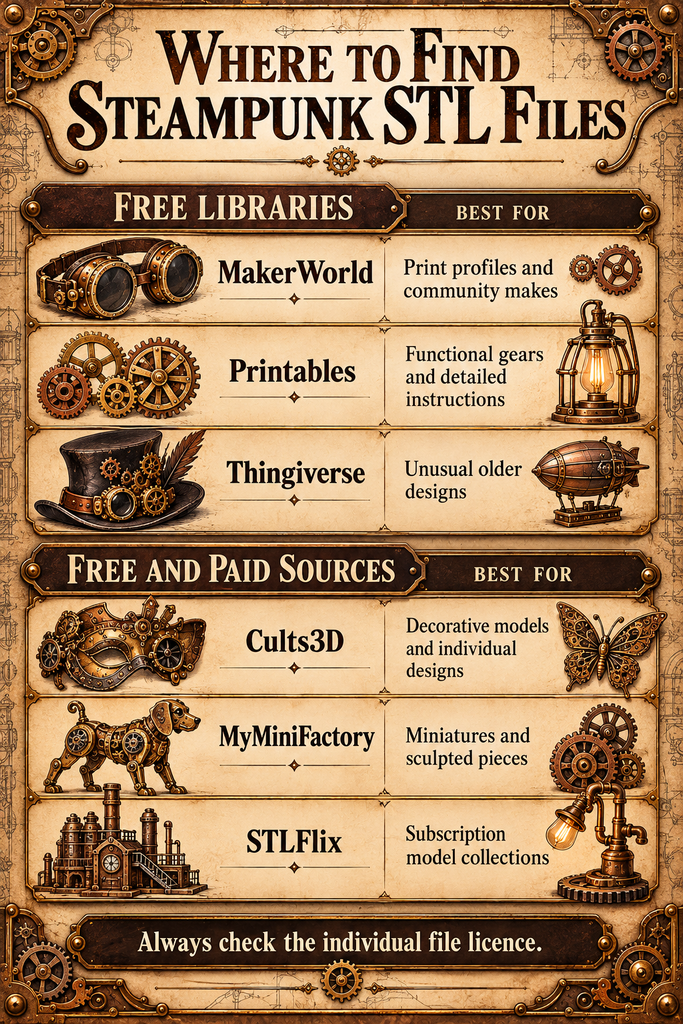
MakerWorld is Bambu Lab’s library. Its strengths are print profiles tuned for Bambu machines and a busy community of makers posting photos, which is a gift when you are judging a file. Bambu has said MakerWorld remains free for personal use, though some creators now offer separate paid commercial licences. A good example of a steampunk find there is the Steampunk goggles – No extra mats needed listing by Dramatic Marmot, which prints with interchangeable lenses and glue-on gears.
Printables (from Prusa) is my pick for functional steampunk. The curation is tidy, the descriptions tend to be thorough and the collections feature is brilliant for browsing. Two verified finds: the Decorative Gear Collection by Peter L, a set of 48 flat gears aimed squarely at steampunk fans, and Steampunk style shop goggles by TickTock, which are properly functional, with multiple lens slots per eye.
Thingiverse is the grandparent of them all. The quality swings wildly, but the sheer age of the catalogue means it holds oddities nobody else has, including steampunk gears, cube gears, canes and goggles, several of which turn up in a roundup of steampunk props to DIY from All3DP. Treat it as a rummage through a very large attic.
Cults3D and MyMiniFactory mix free and paid designs and lean towards sculpted, miniature and decorative work. Both are worth a look for automata-style figures and display pieces. I could not load their current pages while writing this, so check the licence line on each listing rather than assuming.
How to search steampunk effectively
Plain “steampunk” is too broad. Narrow it by object and by how you intend to use it:
- Gears and cogs, with “gear”, “cog” or “gearwork” for wall decor and clock faces
- Wearables, with “goggles”, “monocle”, “top hat clock” or “pauldron”
- Lamp parts, with “lamp shade”, “pipe lamp”, “Edison bulb holder” or “gauge”
- Automata, with “automaton”, “mechanical”, “crank” or “walking”
- Wall decor, with “pipe”, “valve”, “pressure gauge” and “wall plaque”
Add the word “remix” when you want variations, and sort by most-made rather than newest. Quality tends to float.
💳 Paid and Subscription Collections
Paid sources suit two kinds of maker: the person who wants a big, consistent batch of files, and the person who prints regularly enough that hunting through free libraries has become the time-consuming part.
STLFlix is a subscription library. Its own site describes thousands of ready-to-print models, plus courses and a filament store, and mentions a commercial licence in member testimonials. I have not verified current pricing, file counts, steampunk-specific categories or licence terms, so please read the live licence page before you rely on any of it. If you subscribe, hunt for steampunk with the same specific search terms as above.
Marketplaces and designer stores such as Cults3D and MyMiniFactory let you buy individual files or follow a designer you like. This suits you if you have found one creator whose style fits your decor, since you pay for the pieces you will actually print. Paid files usually bring better instructions, tested tolerances and in some cases a commercial licence tier, though that varies by seller.
The rule of thumb: pay when you want reliability, a cohesive set or permission to sell. Stay free when you are experimenting.
🛠️ Where Mythos Aether Forge Fits
Mythos Aether Forge is the shop behind my own 3D printed decor designs, with a planned Steampunk section coming soon. Think of it as the third option beside free and subscription libraries: finished or file-ready pieces designed by a single hand, rather than a catalogue you wade through. I list it here because it is genuinely relevant to the topic, and because a post about finding good files would be dishonest if it pretended the shop did not exist.
⚖️ Licensing in Plain English
This is the part everyone skips, and the part that gets makers into trouble. Every file you download comes with rules from its designer.
- Personal use means you may print it for yourself or as a gift. You may not sell the prints.
- Commercial use means selling prints is allowed, usually subject to conditions. If the listing does not say so, assume it is not.
- CC BY: reuse, remix and sell, provided you credit the creator.
- CC BY-NC: reuse and remix with credit, for non-commercial purposes only.
- CC BY-NC-SA: as CC BY-NC, but anything you make from it must carry the same terms.
- CC0: the creator has waived their rights, so you are free to do as you like.
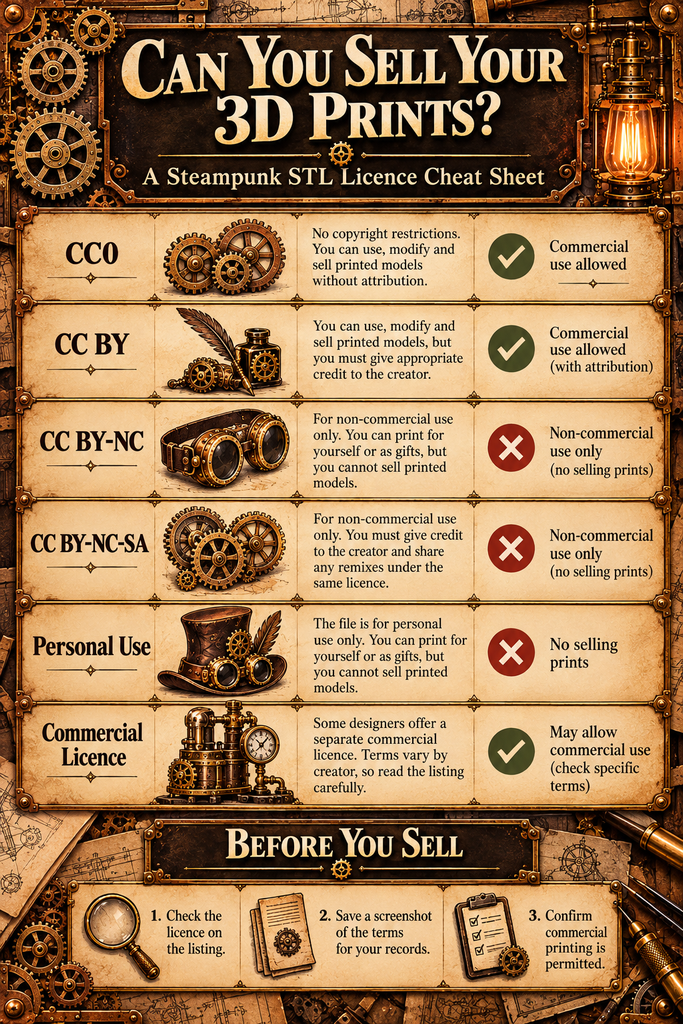
Those summaries follow Creative Commons’ own licence overview. Platforms also add their own licences. The MakerWorld goggles above, for example, carry a MakerWorld-specific licence that bars hosting the file elsewhere and bars commercial use.
The simplest habit is this: before you print anything you might sell, open the file page, find the licence line (it normally sits in the sidebar or under the description) and screenshot it. If it says non-commercial, or says nothing at all, do not sell those prints. If you want to sell steampunk pieces, use CC BY, CC0 or a file with an explicit commercial licence.
🔎 How to Vet a File Before Printing
A few minutes of checking saves a spool of regret.
- Read the makes and comments. Photos from other people’s printers tell you more than the designer’s render. Look for the same machine type as yours.
- Check for print-in-place versus multi-part. Print-in-place gears and hinges are clever but demand a well-tuned machine. Multi-part files are easier to paint separately, which suits aged brass.
- Check supports. Look at the preview in your slicer. If the face you care about is covered in support scars, rotate it or move on.
- Check scale and tolerances. Gears should have visible clearance. If you need a lamp fitting or lens to fit, confirm the stated dimensions rather than trusting the picture.
- Look at the update history. A file that has been revised after feedback is usually a better bet than one posted once and abandoned.
🎯 Your First Project From Each Source
A shopping list, so you leave with something specific to print:
- Printables: the Decorative Gear Collection, printed as a wall cluster. Paint, wash and wax them for an instant steampunk feature wall.
- MakerWorld: the steampunk goggles, as a display or wearable piece. Check that licence first.
- Thingiverse: a set of steampunk gears, then a pair of goggles, as a low-risk way to test the library.
- Subscription or marketplace: one complete lamp or clock design. See my steampunk lighting ideas for how to dress it.
- Mythos Aether Forge: pick a single decor piece to sit among your printed finds and compare designer styles.
If you are still choosing between machines, resin suits fine detail and FDM suits larger decor, but you probably chose already. For a use-case that combines printing with other crafts, my post on DIY steampunk homewares with a 3D printer and a Cricut has plenty of ideas. If you are new to the wider hobby, getting started with steampunk making is a gentler on-ramp.
🔧 Over to the Print Bed
The best steampunk file is one you will actually finish: clean, well-reviewed, licensed for what you want to do with it and detailed enough to look splendid once aged. Start with one project from the list above, print it, ruin it slightly with paint and wax, and then go back for the next.
When your files are sorted, the printing steampunk guide is waiting for the how-to.