Building a Steampunk Wardrobe as a Plus Size Woman
I went looking for plus-size steampunk styling advice before I started building my own wardrobe. Here’s what I found: shopping guides and product grids. “Here are 12 corsets in extended sizing,” full stop, with a photo of a mannequin that looked nothing like me.
As an Amazon Associate I earn from qualifying purchases and sometimes recommend products from other sellers at no extra cost you. For more details see my disclosure policy and privacy policy.
What I didn’t find was anyone actually talking through the fit problems. Most of that content seems to assume “plus size” means one specific body: tall, large-busted, hourglass-shaped. Buy the biggest corset in the range and you’re sorted.
I’m a size 22 to 24, 5’4″, and average-busted rather than the dramatic hourglass the product grids seem to picture. None of that generic advice actually applied to me, so I had to work most of this out myself. This is the guide I wish had existed when I started.
🧭 The gap nobody’s writing about
Plus size isn’t one body. It’s dozens of proportions, all lumped under a single sizing category by retailers who need a shortcut.
If you’re shorter and not particularly busty, a lot of the “just buy an hourglass corset in your size” advice will actively work against you. Pieces cut for a dramatic waist-to-bust ratio can gap, ride up, or just sit wrong on a frame that isn’t built that way.
Recognising that upfront saved me a lot of frustration. If the standard advice isn’t working for your body, that’s not a you problem. It’s a “this advice was never written for you” problem.
📏 Proportion and layering on a shorter frame
At 5’4″, the single biggest lesson I learned is that steampunk’s classic silhouette (long structured jacket, fitted bodice, full skirt) can very quickly overwhelm a shorter frame if you layer it the way taller creators do. A few things that actually make a difference:
Jacket length matters more than anything else. Long coats that hit mid-calf on a taller person will hit much lower on you at 5’4″, which can visually shorten your whole silhouette. Jackets that stop at the hip or high-thigh, worn open, tend to work far better on a shorter frame than anything that goes past the knee.
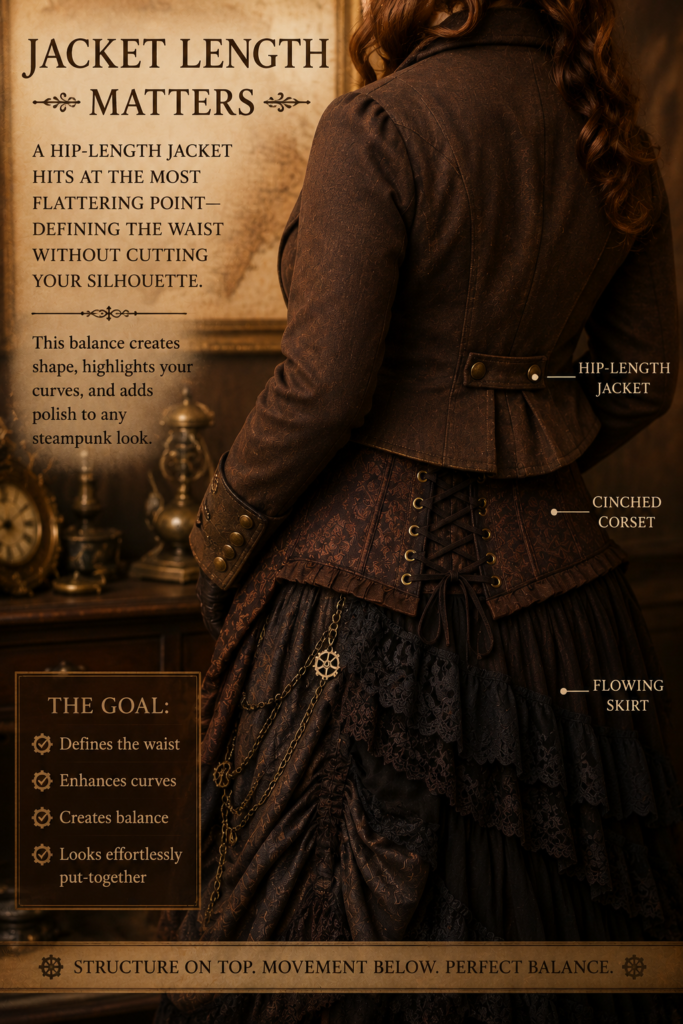
Vertical lines are your friend. Waistcoats with a defined vertical seam, or bodices with visible vertical boning channels or panel lines, do more to elongate a shorter frame than horizontal trim or wide belts. Wide belts especially tend to cut you in half visually rather than defining a waist.
Fitted pieces sit differently depending on your proportions, not your size number. Two people who both wear a size 22 can need completely different cuts, so treat any single “plus size fit tip” as a starting point to test on your own body, not a rule.
🌊 If fitted and structured isn’t your thing (it isn’t always mine either)
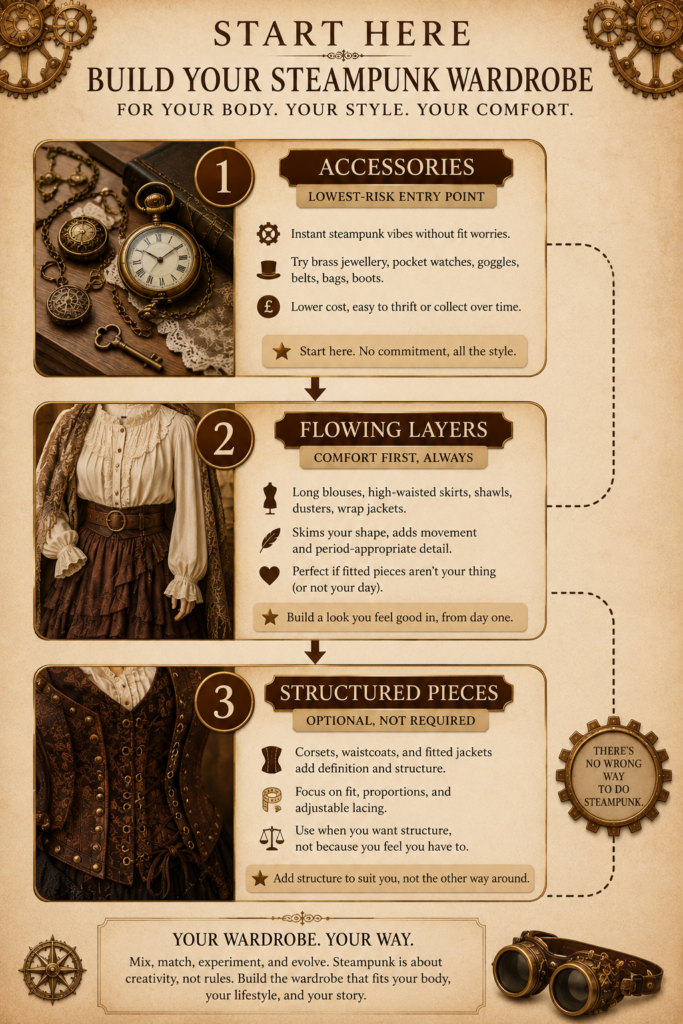
Not every day calls for a fitted bodice, and honestly, not every body feels good in one. If corsets, boning, and structured waistcoats feel intimidating rather than fun, steampunk has a genuinely full wardrobe of flowing alternatives that still read as the aesthetic.
A long Victorian-inspired blouse with full sleeves, worn loose over a high-waisted skirt, gives you the era-appropriate silhouette without a single seam pressing on your body. Layered shawls, dusters, and wrap-style jackets do a similar job: they add drama and period detail while skimming rather than cinching.
This is honestly where I spend most of my own wardrobe budget. Structured pieces get a lot of the spotlight in steampunk styling content, but flowing layers are just as authentic to the aesthetic, and they let you build a look you feel comfortable in from day one rather than working up to comfort later.
🪡 If you do want to try a corset
Some readers will want the structured look, and that’s absolutely part of this aesthetic too, so here’s what’s worth knowing if you decide to go that route. Look for adjustable lacing and structured panels rather than chasing a single “correct” size off a chart.
Generous lacing gives you room to fine-tune the fit over time, since bodies shift day to day and that’s completely normal. Measure your actual natural waistline (the narrowest point above your belly button) before you buy anything, because your size in dresses usually doesn’t translate directly to your corset size.
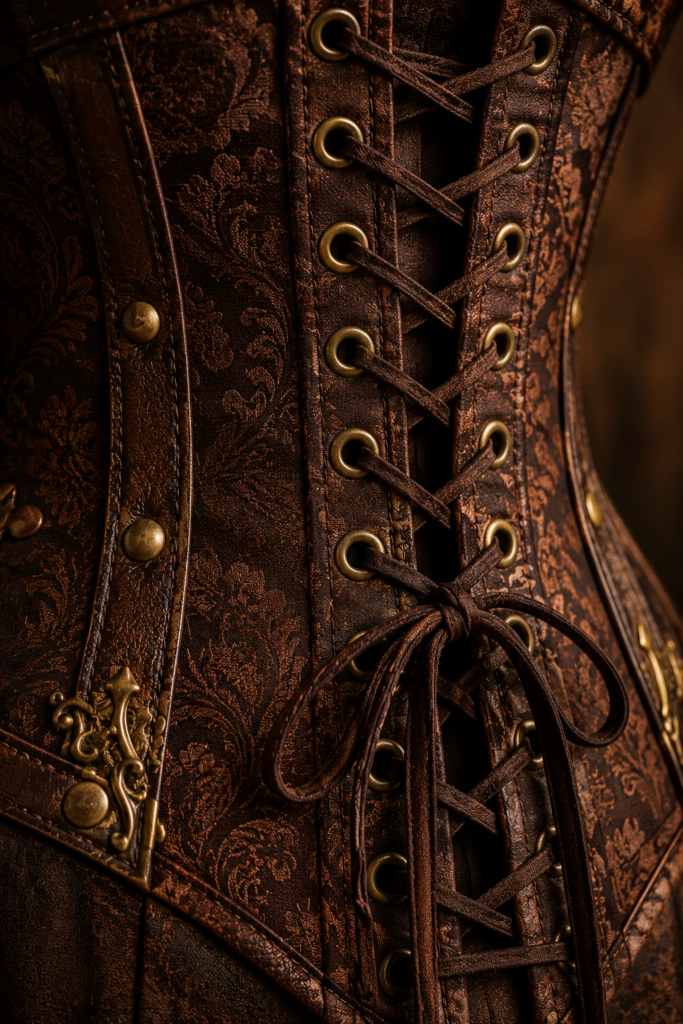
A corset is also not a prerequisite for the aesthetic to “count.” Structured waistcoats and high-waisted skirts create a lot of the same silhouette without the fit stakes of a boned corset, and they’re a much easier starting point while you work out what proportions suit you.
🧵 Mixing thrifted pieces with real steampunk accessories
Full costume sets are expensive, and honestly, they read more like a Halloween costume than an actual wardrobe. Building around thrifted and repurposed basics works much better: a good flowing blouse, a high-waisted skirt, a wrap jacket from a secondhand shop.
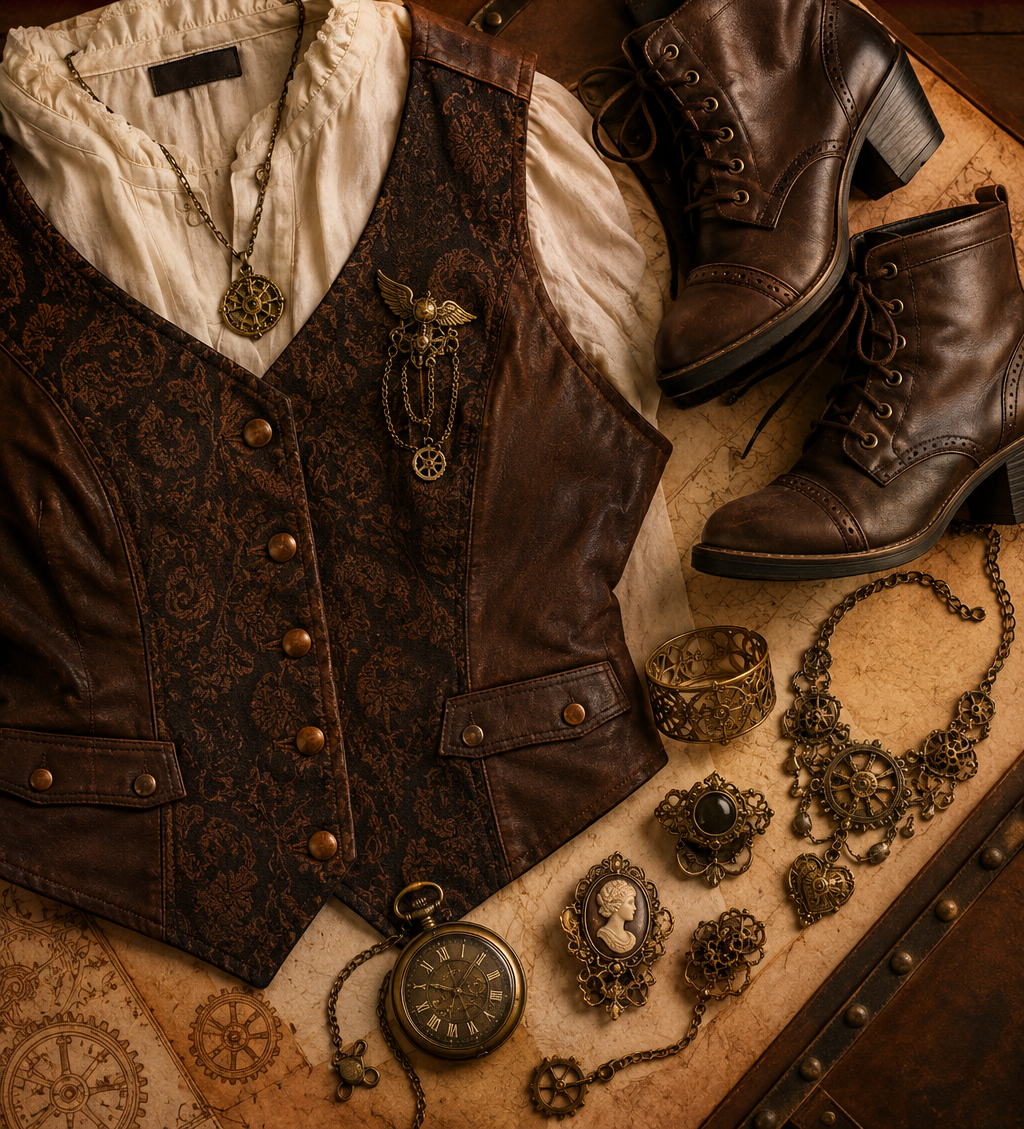
Layer genuine steampunk accessories on top of those basics: brass jewellery, a pocket watch, real leather boots. This keeps cost down, since accessories are a much smaller investment than a full costume, and it makes the look read as your actual personal style rather than something borrowed for one event.
Nobody needs an entire matching set to look like they belong in this aesthetic.
🥽 Accessories: your lowest-risk entry point
If you’re just starting out and not sure which direction to take yet, start here. Jewellery, goggles, and boots carry almost none of the fit risk that structured pieces do.
Brass and copper-toned jewellery (rings, statement necklaces, cuffs) is where I’d point anyone starting from zero. It layers over literally anything you already own, flowing or fitted.
Boots are the next easiest win. A good pair of lace-up boots reads as steampunk instantly, and unlike a corset, sizing is something you already know how to shop for.
🔧 What actually didn’t work
In the interest of the honest version of this post rather than the highlight reel: my first fitted waistcoat was a “one size fits most” cut that sat awkwardly high on my shorter torso and squeezed rather than skimmed. It made the whole outfit look squashed instead of structured.
I had it altered by a local tailor rather than returning it outright, since I liked the fabric and the brass buttons too much to give up on it. That ended up being the better call for pieces you actually like otherwise.
The pattern I’d flag for anyone starting this: if something’s not working, it’s very rarely “your body is wrong for the aesthetic.” It’s usually “this specific cut wasn’t drafted for your proportions,” and there’s almost always a different cut, a different brand, or a tailor’s adjustment that fixes it. And if fitted just isn’t for you at all, that’s a valid answer too, not a problem to solve.
⚙️ Where to go from here
If building rather than buying appeals to you, getting started with steampunk making covers the tools and first projects worth trying. A fair few finishing accessories (goggles, brass hardware, statement pieces) are things you can make yourself once you’ve got the basics down, covered in our 3D printing steampunk props and decor guide.
And if you’re curious how this whole rebrand happened in the first place, why I’m finally letting steampunk take over is the origin story.