
Layering Steampunk Outfits Without Overheating
Nobody warns you, before you fall in love with steampunk, that the whole aesthetic is basically an engineering challenge in heat retention. I learned that the hard way, and I’ve spent more than one summer since then figuring out how to keep the look without melting. Here’s what’s actually worked for me, layer by layer.
As an Amazon Associate I earn from qualifying purchases and sometimes recommend products from other sellers at no extra cost you. For more details see my disclosure policy and privacy policy.
⚙️ The Problem Nobody Warns You About
Here’s the thing steampunk fashion guides don’t lead with: the whole silhouette that makes the aesthetic work (structured layers, high collars, corsetry, coats, gloves, goggles pushed up on your forehead) is basically designed to trap heat. I found this out the hard way, sweating through a full look at an outdoor event in July and wondering why nobody had warned me.
This isn’t a “how to survive Halloween in a costume for three hours” post. If you’re wearing steampunk as an actual ongoing lifestyle, the way I do, you need this figured out for real, recurring situations: conventions, markets, all-day wear, whatever your climate throws at you for most of the year.
🔧 Where the Heat Actually Builds Up
Three areas cause most of the trouble, and it’s worth knowing which ones you can adjust without losing the look.
Torso layers are the biggest culprit. A corset or waistcoat over a shirt, under a coat, is a lot of fabric stacked over your core, exactly where your body needs to shed heat.
Headwear traps heat you don’t think about until it’s too late; goggles, hats, and anything with a brim or strap holds warmth against your scalp and face.
Gloves are the most disposable heat-wise. They look brilliant but they’re also the easiest thing to lose without anyone noticing, since hands are rarely the focal point of a steampunk outfit.
Knowing this hierarchy matters because it tells you what to drop first when things get warm, instead of standing there sweating and not knowing where to start peeling off.
🧵 Fabric Swaps That Keep the Look
The biggest single change I made was rethinking fabric before silhouette. You can keep almost every shape you love and just change what it’s made from.
Linen instead of heavy cotton or wool is the swap that changed the most for me. Linen breathes well and doesn’t hold onto sweat the way heavier fabrics do, and it takes a structured cut nearly as well as cotton twill for waistcoats and lighter coats. It creases more, but honestly, a slightly rumpled linen waistcoat reads as lived-in rather than sloppy, which fits the aesthetic anyway.
Wool isn’t automatically your enemy. This surprised me. A lighter-weight wool, rather than a heavy winter-grade one, actually breathes reasonably well and regulates temperature better than a lot of synthetic “leather-look” fabrics do. If you’ve got a wool waistcoat you love, it might not be the first thing to swap out.
Breathable faux leather is worth hunting for. Not all pleather is created equal; some of the newer breathable, perforated options hold up for accent pieces (belts, small accessories, goggle straps) without the plasticky heat-trap feeling of cheaper vinyl. I wouldn’t build a full coat out of it, but for smaller pieces it’s a real improvement.
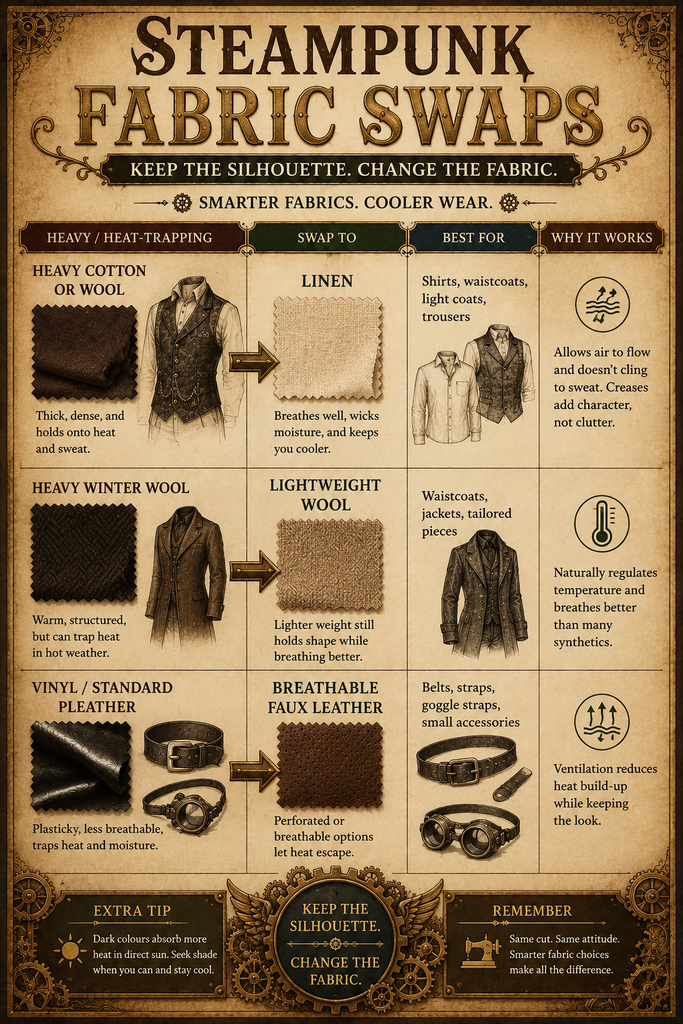
Colour is the one trade-off I haven’t fully solved. Steampunk leans heavily on deep browns, blacks, and burgundies, and dark colours absorb more heat in direct sun than lighter ones do. I haven’t given up my palette over it, but I do actively seek shade at outdoor events now rather than assuming fabric choices alone will keep me comfortable in full sun.
🎩 Hero Layers vs. First-to-Go Layers
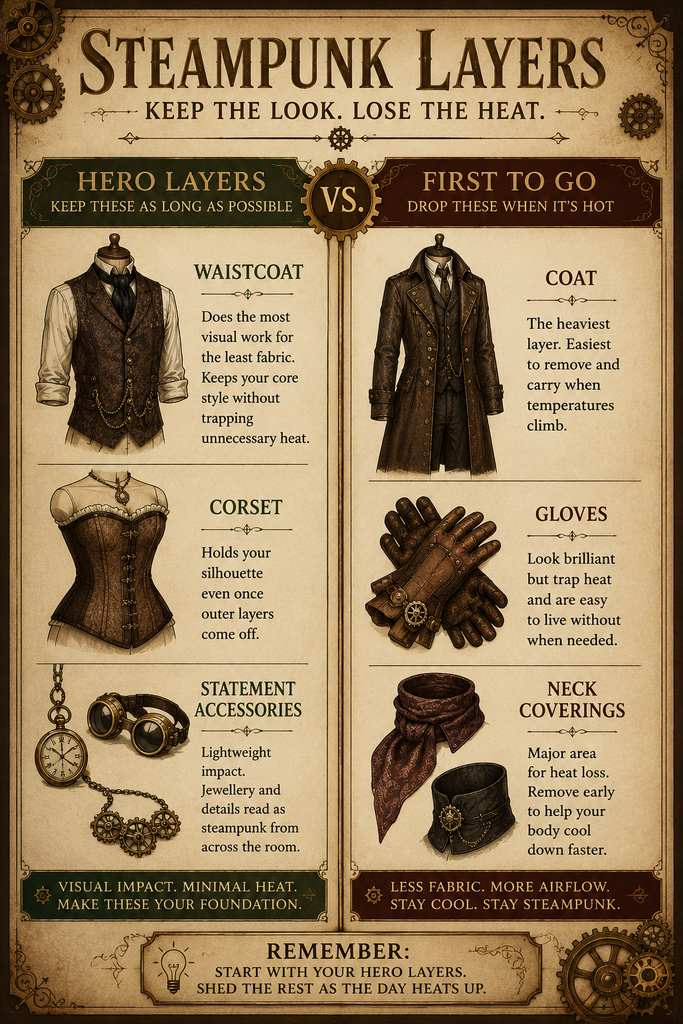
Not every piece in a steampunk outfit earns its place equally when the temperature climbs. I’ve started thinking of my wardrobe in two categories.
Keep these as long as possible (the “hero” layers): the waistcoat, since it does the most visual work for the least fabric; a well-fitted corset if you’re wearing one, since it holds the silhouette even once the coat comes off; and any statement accessory, like a steampunk gear and cog charm piece, since jewellery weighs nothing and reads as steampunk from across a room.
Drop these first when it’s hot: the coat, obviously, since it’s the single heaviest layer and the easiest to carry over an arm; gloves, for the reasons above; and anything covering your neck, since that’s a major area for heat loss.
If you’re working with a corset specifically, an adjustable-lacing underbust corset gives you actual temperature control built in. You can loosen the lacing through the day rather than choosing between “fully structured and roasting” or “not wearing it at all.” That adjustability has honestly done more for my hot-weather comfort than any single fabric swap.
🌡️ Practical Adaptations That Still Read as Steampunk
A few small habits have made a bigger difference than any one piece of clothing:
- Venting where you can. A waistcoat left unbuttoned at the bottom two buttons, or a coat worn open rather than fastened, still reads as intentional styling rather than “giving up.”
- Removable layers as the default plan, not a last resort. I now build every outfit assuming at least one piece is coming off partway through the day, rather than treating it as a failure of the look.
- Accessorising up, not layering up, when I want to add more steampunk detail to an outfit. A cog charm bracelet or a statement ring adds visual interest without adding heat, unlike another layer of fabric.
None of this requires buying a whole new wardrobe. It’s mostly about which pieces you reach for first and which order you take things off in.
🧴 Managing the Practical Stuff Underneath
What’s touching your skin under all those layers matters as much as the visible fabric choices. A moisture-wicking base layer, the kind sold for athletic wear, does more for comfort under a corset or waistcoat than anything marketed as “historical” or “steampunk,” and nobody sees it anyway.
Clinical-strength antiperspirant applied the night before an event, rather than the morning of, genuinely holds up better through a long day in heavy layers. It’s a small, unglamorous habit that’s made more difference to my actual comfort than most of the fabric swaps above. A small travel fan and a pack of cooling wipes tucked into a bag are worth the space they take up at any all-day event.
None of this shows up in a single photo, but it’s the difference between enjoying eight hours in a full look and counting down the minutes until you can take the coat off.
🎪 Troubleshooting Specific Hot-Weather Scenarios
All-day conventions: pack a lightweight tote for shed layers so your coat and gloves don’t end up as dead weight in your hands for six hours. Wear your hero layers from the start and plan your “drop” layers as things you can put back on for photos, then remove again.
Outdoor markets or fairs: lean harder into linen and skip the coat entirely if you can, building the look around a waistcoat and accessories instead. Nobody’s going to clock the missing coat if the rest of the silhouette is doing its job.
Long days of general wear: this is where the fabric swaps matter most, since you don’t have the adrenaline of an event carrying you through discomfort. A linen-heavy, lightly-accessorised version of your usual look will get you through an ordinary hot day far better than your full convention outfit will.
Photoshoots and posed events: wear your full look, coat included, only for the minutes you’re actually in front of the camera, then change back into your reduced hot-weather version between shots. Photographers are used to this, and it saves you from standing in full layers for an entire session just for a handful of usable photos.
This is genuinely still a learning process for me, not a solved problem. Every season I adjust something new, usually after getting it wrong the previous summer. If you’ve found a swap or a habit that’s worked for you, I’d love to hear it; this is exactly the kind of thing that gets better with a whole community comparing notes rather than one person figuring it out alone.